26 November 2026
Wedding

- Home
- About me
-
Services
Add memories of every moment
Giovanni PapiniTHE SERVICES I OFFER - Projects
- Print Online
- Contact me


It’s one of the questions that comes up most often in initial messages, almost always asked with a touch of embarrassment: who pays the wedding photographer – the bride and groom or their families? There’s no hard and fast rule, and customs have changed quite a lot in recent years. In this guide, I’ll try to clarify how things used to work, how they usually work today, and, above all, how to reach a clear agreement before the question becomes a problem just a few months before the wedding.
In the most traditional Italian custom, the cost of the photography service was often one of the items covered by the bride’s family, along with other wedding expenses such as the dress or the reception. This division of costs was characteristic of a time when it was almost always the families who organised and paid for the entire event, with the bride and groom themselves playing a lesser role in the financial arrangements.

Nowadays, most of the couples I work with are getting married at a higher average age, with a stable job and financial independence, and this naturally changes the way they share the costs. It is no longer a given that only the families will foot the bill: in many cases, the bride and groom themselves cover the entire cost of the wedding, including the photographer, whilst in other cases the families continue to contribute, but on an agreed basis rather than as an automatic tradition.
One aspect of the tradition that has partly survived is the voluntary contribution: it still happens that a family chooses to cover the cost of the photographer as a wedding gift – a tangible gesture rather than an obligation felt as such. In such cases, what has changed compared with the past is that the decision is almost always discussed openly with the bride and groom, rather than being taken for granted.
In my current practice, I mainly come across three different ways of splitting the costs of a photo shoot, and none of the three is any more “fair” than the others: it depends on the circumstances of the couple and the families involved.
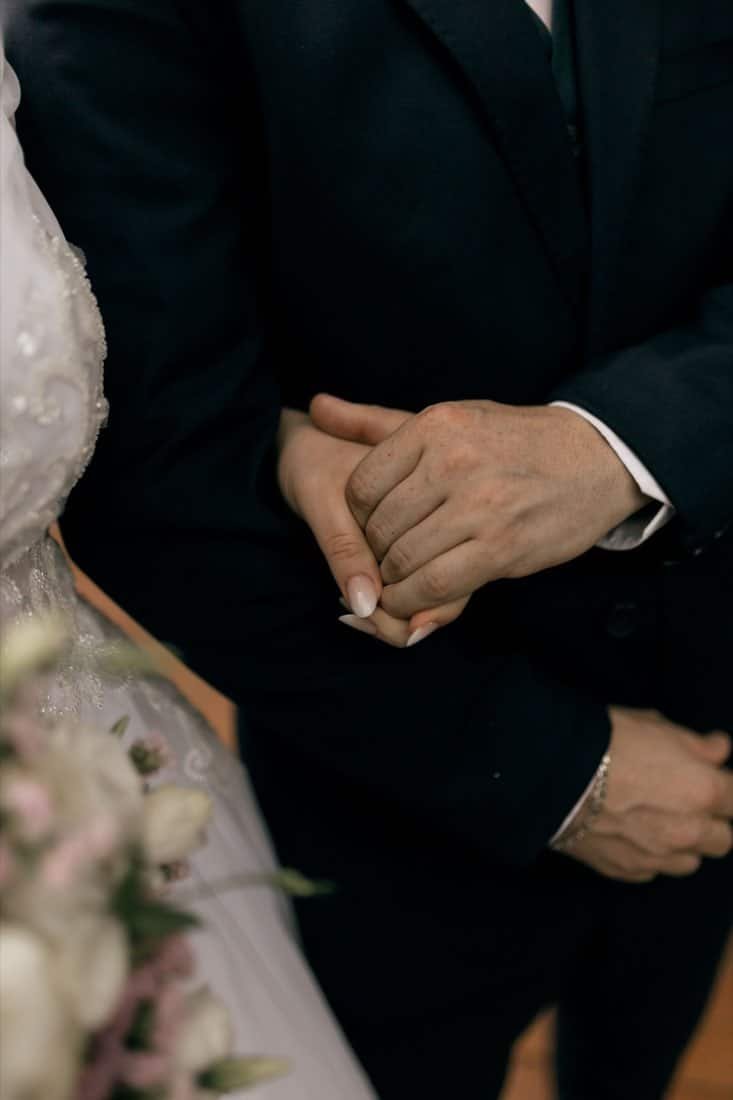
This is the most common option amongst couples who organise their wedding themselves, often with a budget planned well in advance. In this case, the photographer is chosen and discussed directly by the bride and groom, who decide how much to spend based on their own priorities: some allocate a significant portion of the total budget to the photography, as they consider the photos to be the most lasting memento of the day, whilst others prefer a more modest package so they can allocate resources to other areas.
A very common arrangement is an agreed split: families contribute towards part of the cost, perhaps specifically for the photography package or an add-on to it (a second photographer, a video, a printed album), whilst the bride and groom cover the rest. This works well when communication is clear from the outset, avoiding misunderstandings about who decides what when the costs are shared.
In some cases, a family chooses to cover the entire cost of the photo shoot as their wedding gift, leaving the bride and groom to manage the other expenses. This is a solution that makes things much simpler from a practical point of view, provided it remains clear who has the final say in choosing the photographer and the style of the shoot: the gift works best when the bride and groom are involved in the decision-making process, not just in the final result.
Still not sure how to break down this cost item? Let’s have a chat – I’ll help you understand what a proper quote should include so you can make a more informed decision.
The moment when the question of “who pays” really causes tension is not the decision itself, but the lack of a clear agreement before contacting suppliers.
The most useful advice I can give – regardless of how you choose to split the costs – is to reach an agreement before you start comparing quotes, not halfway through the negotiations. It often happens that a couple start talking to a photographer on the assumption that the cost is already being covered by one family, only to discover later that the expected contribution was different from what they’d imagined. Clarifying this in advance avoids having to renegotiate everything at the last minute before booking.
It is not uncommon for expectations regarding the photography service to clash with the budget actually available, particularly when several people are contributing towards the same expense. In such cases, the simplest solution is to be transparent with the photographer right from the start about the budget you have available: a reputable professional will know how to adapt their proposal — the duration of the shoot, the number of hours, the inclusion of a second photographer — without compromising on the quality of the work.
Would you like to find out how to tailor a photo shoot to the budget we’ve agreed on together? Drop me a line, and we can have a proper chat about it.
Whatever arrangement is agreed upon regarding the division of costs, there is one point that always applies, without exception: the contract and the quotation must be made out in the name of and signed by the person who assumes financial responsibility towards the photographer; they must not be left as an informal agreement between the parties.
If a family is paying for the entire service or a significant part of it, it is important that this is clearly stated in the documents: the header of the quotation, the payment terms for the deposit and the balance, and the main point of contact for organisational matters. This is not a bureaucratic formality for its own sake: it prevents misunderstandings about who should be contacted regarding practical decisions in the months leading up to the wedding, and about who is entitled to receive the photographs and discuss any changes to the agreed package.
You can also find a more general guide on How much does a wedding photographer cost in Tuscany?, which will help you get an idea of your budget before deciding how to allocate it. Wedding photographer in Tuscany.
As well as who is responsible for the total cost, there is a practical matter that is worth clarifying right from the first quote: how and when the deposit and the balance are paid, and who actually handles these payments.

Almost all photographers, myself included, ask for a deposit when the contract is signed to secure the date in their diary: this is standard practice, not a sign of mistrust towards the couple. If the cost is shared between the couple and their families, it’s best to decide straight away who will pay this initial sum, precisely because the date is only secured once the payment has been made, not simply by requesting a quote. Delaying the decision on who pays the deposit is one of the most common reasons why a couple lose a date they had already chosen.
Payment arrangements vary from photographer to photographer: some request payment in the days immediately leading up to the wedding, others on the day itself, whilst others split the amount into further instalments throughout the year of planning. If several people are contributing towards the cost, it is useful to know in advance when the final payment is due, to avoid having to sort it out in a rush during the busiest days of the planning, when your attention is already taken up with a thousand other details.
Would you like to know how my payments are structured, including the deposit and the balance? I’ll explain it clearly in the quote.
Is it still the norm for only the bride’s family to pay? It is a custom that is increasingly less commonly followed as a matter of course: nowadays, most couples decide how to split their expenses on a case-by-case basis, without taking a traditional approach for granted.
What happens if the family who were supposed to contribute changes their mind a few months before the wedding? This is one of the main reasons why it is worth setting out the agreement in writing right from the start: if your financial situation changes, it is better to know as soon as possible so that the service can be adapted to the new budget, rather than finding out at the last minute.
Can the photographer issue two separate invoices if several people are contributing to the cost? In most cases, yes, but this needs to be agreed in advance: it is easier to clarify in advance who will receive the main invoice than to amend it after the contract has been signed.
Should the bride and groom still be involved in choosing the photographer, even if they aren’t paying for them? Yes, it’s always a good idea: the photo shoot captures your big day, so it’s only right that the style and the photographer you choose reflect your tastes, regardless of who’s footing the bill.
Is it rude to ask the family directly whether they intend to contribute to the cost of the photo shoot? No, quite the opposite: a direct question asked well in advance avoids far more awkward situations than a prolonged silence, which leads to misunderstandings later on in the planning process.
Is there an average percentage of the total wedding budget that should be set aside for the photographer? There is no fixed percentage that applies to everyone: it depends on how much priority the couple places on the photographic story compared to other aspects, such as the venue, catering or music. It is better to set a realistic budget based on your own priorities than to stick to a standard percentage.
If the deposit is paid by a family, should the contract still be in the spouses’ names? Not necessarily: the important thing is that the person paying the deposit and the balance is the same person or the same household as specified in the contract, to avoid any confusion later on. If the situation is a bit mixed, simply make this clear to the photographer before signing, so that the document accurately reflects how you have organised things.
 Italian Italian
 English