9 November 2026
Wedding

- Home
- About me
-
Services
Add memories of every moment
Giovanni PapiniTHE SERVICES I OFFER - Projects
- Print Online
- Contact me


In recent years, almost every couple I meet asks me, sooner or later, whether I also film with a drone. The short answer is yes, but the useful one is different: drones aren’t suitable for every wedding in the same way, and understanding when they really add something to your story – rather than being just a technological gimmick – is what’s worth knowing before you ask your photographer. In this guide, you’ll find out what a drone can really capture, when it’s best to leave it on the ground, and how it fits into the day without becoming yet another thing to worry about.
The view from above isn’t just “more beautiful”: it’s a perspective that simply doesn’t exist at ground level. An aerial shot reveals the layout of the venue, the size of the garden, how the guests are arranged around the bride and groom, and the outline of a path or a row of cypress trees as seen from above. This is information that the final edit uses to give the narrative a sense of space, particularly in the opening and closing shots of the video, when it’s important to show where you were before delving into the details of the faces and moments.
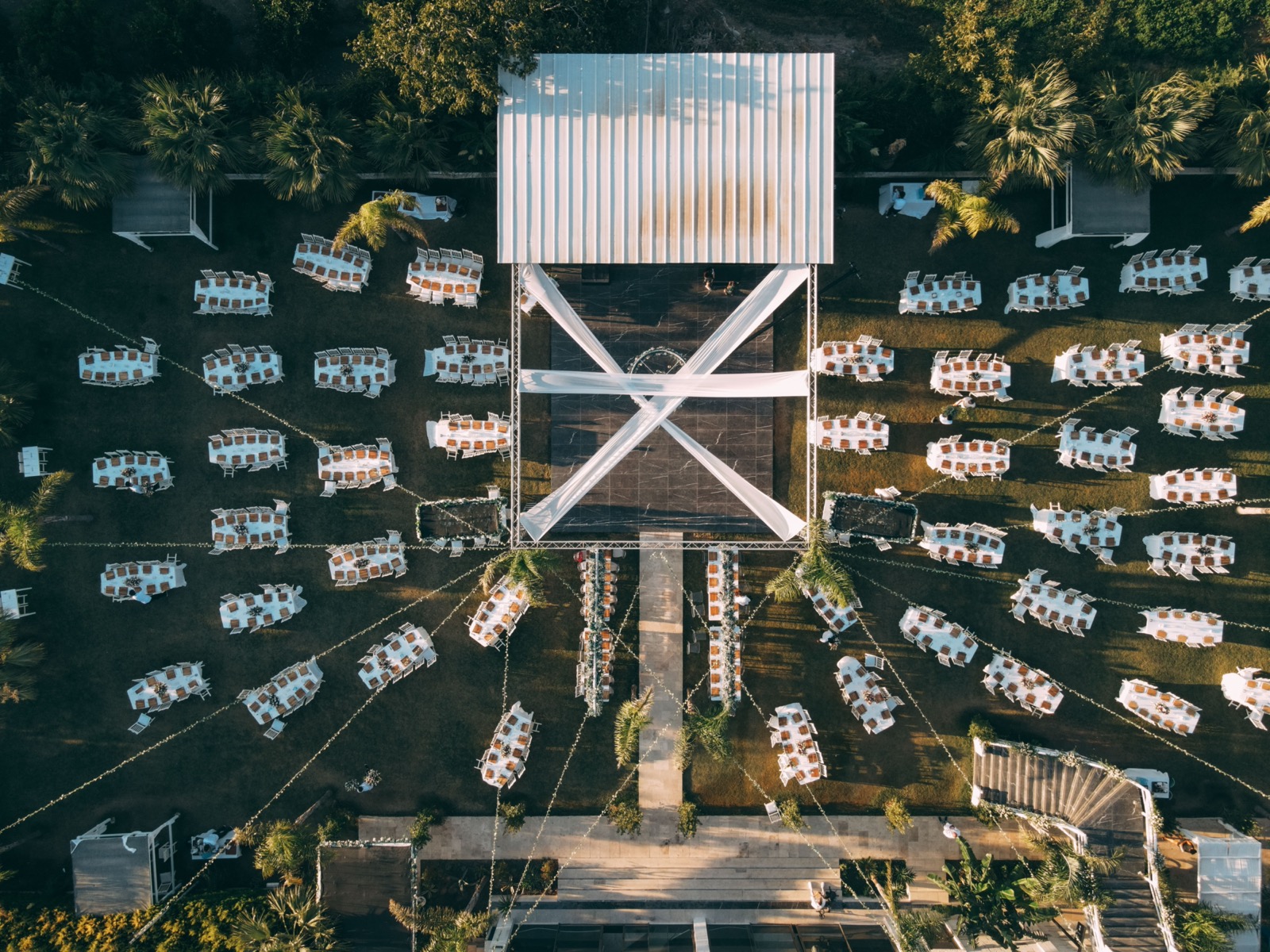
There is also a second, less aesthetic reason: the drone can capture a group moment — the exit from the church, the throwing of rice, an outdoor toast — without having to choose between two or three people, as is almost always the case on the ground, where space and obstacles limit the shot. It’s the same difference as between narrating a scene and describing it: from the ground, you narrate who is there; from above, you describe where they are; and the final video needs both to feel complete.
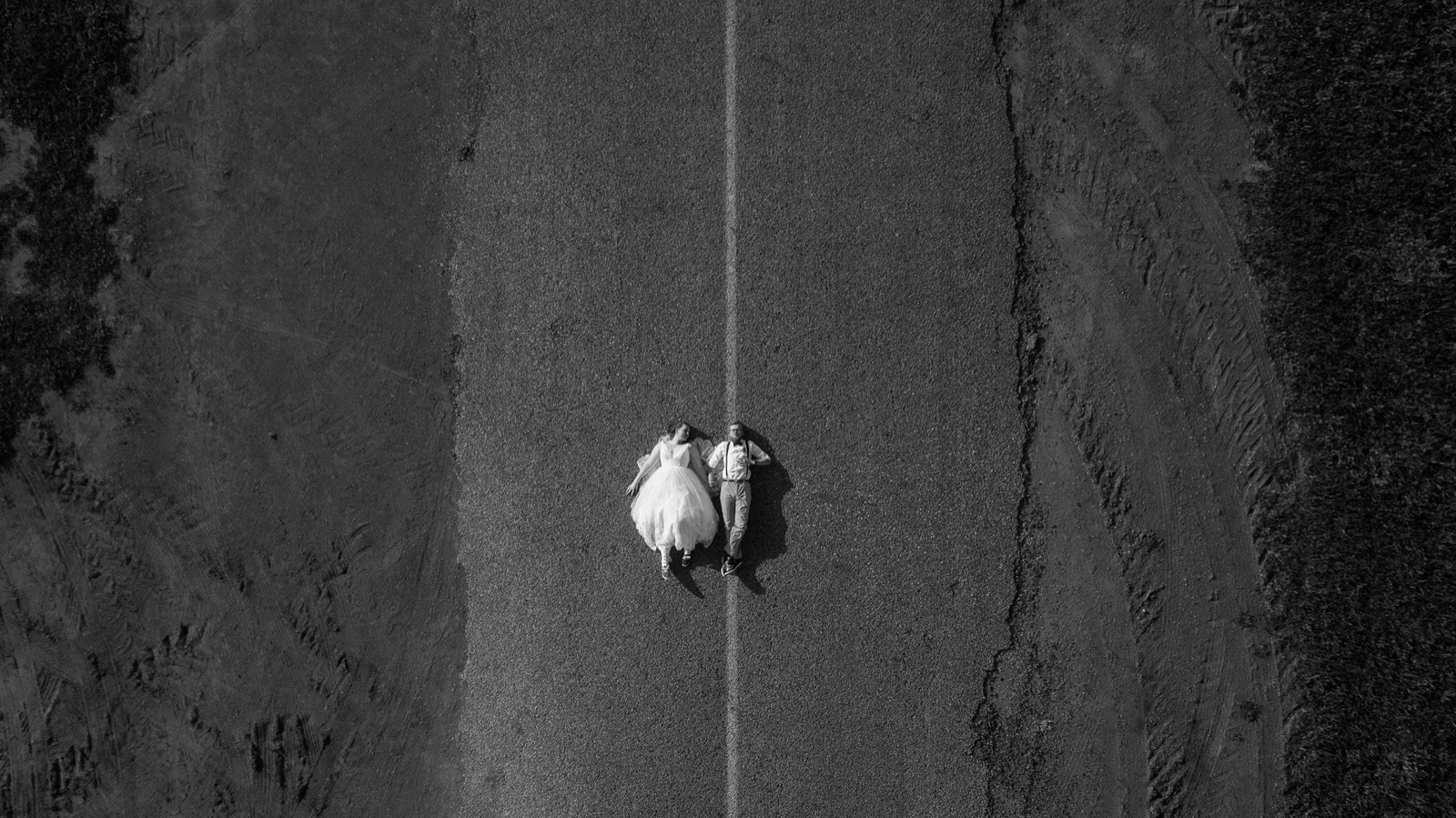
In the final video, aerial shots almost always serve as an opening or a closing: a shot from above showing the location as the music begins, or a final glimpse of the place where it all happened, as the credits roll. It works less well when inserted in the middle of the story, between two closely related ground-level scenes: there, it risks simply disrupting the flow rather than adding anything.
Do you already have a particular moment in mind that you’d like to see from above? Let me know and we’ll work out together whether a drone is the right tool for that shot.
Some couples tend to think of the drone as an extra that “does everything on its own”, perhaps to save money on other aspects of the service. It doesn’t work like that: the drone captures the venue and the group moments from above, but it doesn’t replace the work on the ground, which is what captures the faces, the glances and the details that you’ll end up looking at most often over the years. They are two complementary tools, not alternatives: one provides the context, the other captures the people.
That’s why, when I draw up a quote, I treat the drone as an addition to the main photography and videography service, not as a substitute for any part of it. If the budget is limited, I always prefer to explain honestly where it’s best to invest first.
An aerial filming session usually lasts just a few minutes for each chosen moment: it isn’t something that requires a separate slot in the day’s schedule, but it does need to be planned, as the drone needs a moment to take off, stabilise and find the right shot. That’s why it’s best to know in advance which locations and times of day are most suitable, rather than deciding everything at the last minute.
It’s also worth bearing in mind that a drone’s battery has a limited runtime: for a day involving multiple locations (pre-wedding preparations, the ceremony, the reception), you’ll need to have several spare batteries ready; otherwise, you risk running out of power just when it matters most. The same applies to the weather: checking the forecast in the days leading up to the event – not just on the morning itself – helps you work out well in advance whether it’s better to schedule the aerial shots for a specific time of day, rather than leaving it to the last minute and hoping the wind will die down.
Do you need a pilot with a licence to film with a drone at a wedding? Yes, professional drone filming requires a pilot who is qualified in accordance with current regulations, with registered equipment: this is one of the first things you should check with anyone offering this service – not just the photographer, but the person who will actually be flying the drone on the day.
Does the drone make a noise or disturb the ceremony? A modern drone, flown at the correct distance, produces minimal background noise; however, the most appropriate course of action is still not to fly it during the actual exchange of vows or the ceremony itself, out of respect for the occasion: it is customary to fly it before, after, or during the reception, when the circumstances allow.
Can the drone also be used in the evening, during the reception? In theory, yes, but there are more restrictions: low light makes the footage less clear, and in many areas flying at night requires specific authorisation. For this reason, evening drone filming is less common and must be assessed on a case-by-case basis.
What happens if the weather isn’t favourable on the wedding day? If it’s too windy or rainy, the drone simply won’t fly, for safety reasons: it’s not a service that can be forced. In that case, the story of the day remains complete thanks to the work carried out on the ground, and the aerial footage simply becomes an element that cannot be included on that particular day.
Is the drone always included in the photography package, or is it a separate extra? In most cases, it’s a separate item, precisely because not all couples want or need it: you can also find it in the article on How much does a wedding photographer cost in Tuscany?, where I explain how to break down a quote item by item.
How many drone shots are needed on a wedding day? There’s no need to go overboard: two or three well-chosen moments — an arrival, a detail of the venue, a snapshot of the reception — are almost always enough to give the video all the depth it needs. Filling the edit with aerial shots ends up tiring the viewer rather than impressing them.
I don’t include the drone in every shoot just for the sake of it: there are weddings where it simply doesn’t add anything extra, or where it simply can’t be used.
Many historic venues – particularly villas subject to landscape conservation orders or areas near airports, military zones or densely populated areas – have specific restrictions on drone flights, and sometimes prohibit them entirely without exception. The rules vary from area to area and may require specific authorisations: it is always best to check with the venue itself well in advance, rather than assuming that you will be able to fly a drone on the wedding day. If the venue does not permit it, I make this clear before including it in the quote, so that it does not end up as a promise that cannot be fulfilled.
Even when it is permitted, there are circumstances in which it is not safe to fly a drone: strong winds, confined spaces surrounded by trees or tall buildings, or an event taking place entirely indoors. In such cases, there is no point in forcing the issue: it is better to capture those moments with a camera on the ground, where there is a greater margin for safety and better image quality. I always prefer to forego a shot that risks turning out badly or, worse still, being dangerous, rather than insist on taking it simply because it had been promised in advance.
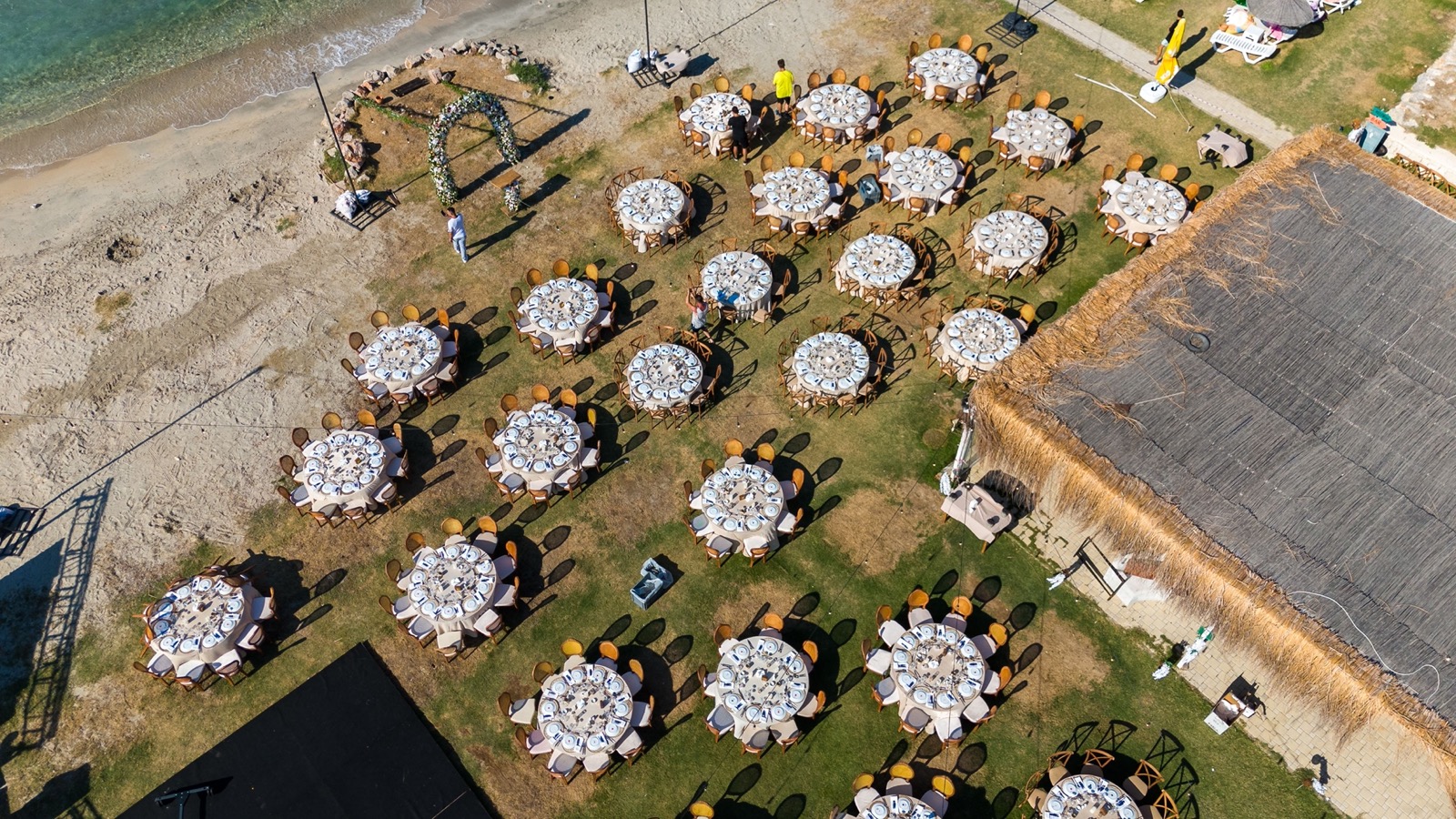
If you’re not sure whether your location is suitable for a drone, send me the name or a few photos: I’ll check it out first.
An aerial shot takes just a few minutes, but these moments need to be chosen carefully: it works best during moments already included in the schedule — arrival at the venue, a moment during the outdoor portraits, leaving the ceremony — rather than creating a specific break just for that. In this way, the drone adds an extra perspective without becoming a disruption that guests notice or that takes time away from the rest of the coverage.
The opposite also holds true: if a moment deserves our full attention on the ground, I won’t sacrifice it to chase an aerial shot. The drone remains a complement to the main narrative, not the other way round.
When a shoot involves both photos and videos on the ground as well as drone footage, someone has to coordinate the timing: it is almost always the person managing the day’s schedule who gives the pilot the go-ahead at the right moments, not the other way round. This prevents the drone from taking off just as something unmissable is happening on the ground, and ensures that the two types of footage are completed rather than overlapping haphazardly. It’s one of the reasons why I prefer to discuss this in advance with those in charge of the aerial footage, rather than improvising on the day itself.
Would you like to know at what points in your day the drone would fit in best? Let’s discuss it when we’re putting the schedule together. Wedding photographer in Tuscany.
Ultimately, the right question isn’t “do I want it or not?”, but “what does it really add to my day?”: if the answer is a view you could never get from the ground, then it makes sense.
 Italian Italian
 English